
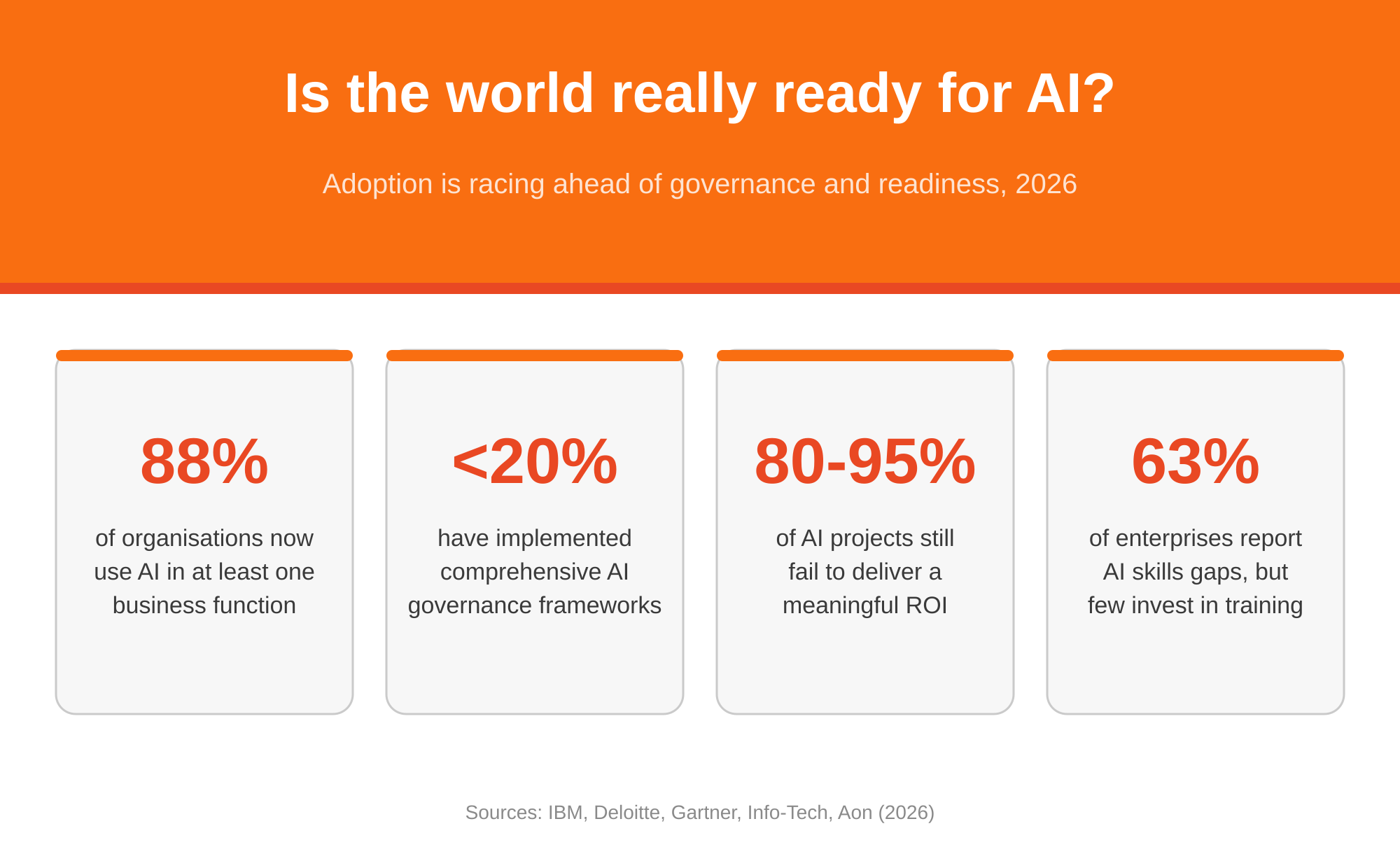
Artificial intelligence has moved from experimentation to everyday infrastructure faster than almost any technology before it. By 2025, 88 percent of organisations reported using AI in at least one business function, up from 78 percent the year before. Yet as adoption accelerates through 2026, a more uncomfortable question is emerging: has readiness kept pace with rollout?
The numbers suggest a widening gap. Info-Tech’s Future of IT 2026 survey found 58 percent of organisations have now integrated AI into enterprise-wide strategy, a dramatic jump from just 26 percent the year before. But fewer than 20 percent have implemented comprehensive AI governance frameworks, and under a quarter regularly assess the risks in their own deployments. Deloitte’s 2026 enterprise research found a similar pattern: more companies now believe their strategy is well prepared, yet they report feeling less prepared than before on the practical basics of infrastructure, data quality and talent.
Data itself remains a major obstacle. Fifty-six percent of companies cite poor data quality as a significant barrier to AI adoption, and analysts at Gartner expect roughly 60 percent of AI projects lacking properly prepared data to be abandoned. Meanwhile, most AI initiatives are still failing to deliver a return: estimates suggest that between 80 and 95 percent of AI projects fail to produce meaningful ROI, with the cause typically traced to weak data and integration rather than the underlying models themselves.
The workforce dimension is just as pressing. Sixty-three percent of enterprises report skills gaps in AI governance, data literacy and leadership alignment, yet only 28 percent are investing in formal training to close them. Analysts have put the potential cost of this leadership gap as high as $4.4 trillion in lost productivity if organisations fail to close it. Public sentiment reflects similar caution, with safety concerns and fears over job displacement cited as the leading worries among ordinary people encountering AI in daily life.
It is not all warning signs. Adoption of agentic AI, systems that can plan and complete multi-step tasks with limited supervision, is accelerating quickly, and Gartner projects that 40 percent of enterprise applications will include task-specific AI agents by the end of 2026. Search itself is already transformed: Google’s AI Overviews now reach more than two billion monthly users, and ChatGPT passed one billion active users in 2026, changing how millions of people find information every single day.
The picture that emerges is one of a world adopting AI faster than it is preparing for it. Capability is advancing quicker than governance, oversight and training can follow, and the organisations succeeding are those treating readiness, not just deployment, as the real project. Until data quality, governance and workforce skills catch up with enthusiasm, the honest answer to whether the world is ready for AI is: not quite, but it is catching up fast.
